Montrose 9

0-3j9joqjo_p92dd1j-2
Photo by Erik McGregor

‘Heroes’ Sentenced for Blocking Fracked Gas Pipeline Construction Near a Nuclear Facility

Originally appeared on Occupy.com

Nine New York activists known as the “Montrose 9” received sentences of fines and community service on Friday for their misdemeanor crimes blockading access to a Spectra Energy construction yard in November 2015.

Following the verdict, the activists filed an appeal on the stance that their actions were necessary to prevent harm to the public by halting construction on Spectra’s AIM pipeline, a high-pressure, 42-inch pipeline transporting fracked natural gas dangerously close to critical safety infrastructure that protects a decaying nuclear facility less than 50 miles from New York City.

If the pipeline ruptures near the adjacent nuclear facility, the catastrophe could force more than 20 million people to evacuate. Martin Stolar, of the National Lawyers Guild, is arguing the activists’ defense strategy, known as “necessity defense,” has precedent in other instances – like breaking and entering a burning school building to save a kindergarten class trapped inside, and more similar cases like the “Delta 5” in Washington state.

It was a legal landmark that Courtlandt Town Court Judge Daniel McCarthy even considered hearing this defense, though he rejected the activists’ argument. The sentencing was handed down on the same day, Jan. 6, that New York Gov. Andrew Cuomo announced a plan to shut down the Indian Point nuclear power plant.

McCarthy’s decision, made before a crowded courtroom of Montrose 9 supporters, came despite testimony from nuclear and pipeline experts, public officials and community members who criticized the pipeline’s proximity to Indian Point, explaining that it creates unwarranted health, safety and environmental risks at local, regional and even global levels. The nine activists were each instructed to pay $375 in fines and service fees and five hours of community service.

The defendants were unmoved by the court’s decision.

“It‘s difficult for me to think of myself as ‘guilty’ when I was trying to stop a possible catastrophe,” said Linda Snider, one of the nine defendants. “The first part of the Spectra pipeline is now in place and running under the Hudson, right next to a proposed oil barge anchorage site and Indian Point Nuclear Power Plant in Tompkins Cove. What could go wrong?”

Spectra Energy was not reached for comment. But in December, following the Montrose 9’s guilty verdict, Spectra spokesperson Marylee Hanley told the Peekskill Post, “We agree with the decision of the court.” Hanley added, “We respect the right of individuals to protest, except when those actions violate the law and create potentially unsafe conditions.”

The defendants’ argument hinges on the interpretation of “imminent danger” – in this case proving that the pipeline construction blockade was necessary to prevent a disaster far more harmful to the public’s interest than the damages the corporation suffers for reduced productivity. The defendants face the additional burden of proving evidence that all other legal and regulatory avenues for reform were exhausted prior to breaking the law.

Stolar filed an appeal with the appellate division of the Westchester County Supreme Court. This is not the first case in which Stolar made the necessity argument in defense of climate activists. Stolar is seen here answering questions following the Montrose 9 sentencing.

“I am extremely disappointed with respect to the necessity defense, which seems so obviously true,” said Stolar. “[The defendants] are heroes, not criminals.”

Strong Defense

Prior to risking arrest, the Montrose 9 activists attended every open house, scoping meeting and hearing on the AIM pipeline. They led postcard and letter writing campaigns, held community engagement meetings and met with public officials, winning many of them over to their cause. This was all presented as evidence to Judge McCarthy. And even internationally renowned nuclear expert Paul Blanche, in addition to physicist and pipeline expert Paul Moskowitz, testified on the defendants’ behalf, speaking of the overlooked danger and urging intervention from the federal regulatory commission for energy infrastructure projects.

Despite the actions taken by the Montrose 9 and other activists to prevent Spectra Energy from finishing construction on the pipeline – and in addition to opposition from local residents, officials, Gov. Cuomo and U.S. senators Chuck Schumer and Kirsten Gillibrand – natural gas has been flowing through the AIM pipeline since the start of 2017.

Westchester County Assistant District Attorney Janelle Armentano and Supervisor Anthony Molea did not call a Spectra Energy representative as a witness in the Montrose 9 case. Four police officials were called as witnesses, and one high-ranking official complimented the activists’ professionalism and courtesy, seeing this as a first amendment rights issue. In his testimony, the official said he was more concerned for the local activists’ safety during the blockade, because the Spectra Energy pipeline workers were from out of town, not members of the community.

The activists are now in the process of purchasing court transcripts, at which point they will make the document publicly accessible. “All of the pieces of government have failed us, and now the judicial system has failed us,” said defendant Mike Bucci. “Where do we go for protection?”

Due to government’s inability to halt the Spectra construction at the community’s request, regional activists are planning more direct actions.

“Although we have been found guilty, it will not deter us from continuing to peacefully fight the next two segments of the Spectra pipeline every inch of the way,” said defendant Monica Hunken. “Whatever punishment we receive is a small price to pay for defending the land, air, water and our precious communities.”

0-96tjyejpfywaii0k-2
Photo by Erik McGregor

RISKY BUSINESS

To date, Spectra has only completed one of three adjacent pipeline expansion projects connecting the Northeast Atlantic region and Canada. The Algonquin Pipeline Expansion takes its name from a populous and widespread network of North American native languages and communities known as the Algonquian peoples.

The activists believe Spectra Energy has intentionally disguised the project as three independent pipelines — employing a loophole know as “segmentation” — in order to circumvent its legal obligation to submit documentation to the Federal Energy Regulatory Commission (FERC) identifying the collective impact of the three projects as a whole.

Spectra Energy says the gas flowing through the AIM pipeline is needed for cold northeastern winters, but the activists say that gas is intended for export as liquefied natural gas. In 2015, Massachusetts Attorney General Maura Healy published a study showing that the Northeast does not need the gas that Spectra is claiming to provide. In 2016, Spectra Energy was caught attempting to pass along to Massachusetts consumers the costs of signing up for pipeline gas, prompting utility companies to withdraw doing-business petitions.

In early 2016, Gov. Cuomo called for an immediate halt to construction of the pipeline while the state conducted an independent risk assessment. Later that summer, senators Schumer and Gillibrand wrote to FERC calling for an immediate halt to construction of the pipeline as well, remarking on the “continued public comment in opposition to this project” and “considerable opposition from affected communities and elected officials.” FERC denied both official requests.

In November 2016, revelations showed that Phil Suter, the spouse of Maggie Suter, a high-ranking FERC official who led the review for two other pipeline projects proposed by Spectra, is a paid consultant for Spectra.

LEADING THE OPPOSITION

Most of the Montrose 9 defendants are involved with the group Resist Spectra, a grassroots organization leading the fight against the pipeline. “Spectra Energy’s ‘Algonquin’ fracked gas transmission expansion to the Maritimes is illegally segmented into three parts — AIM, Atlantic Bridge and Access Northeast,” said Kim Fraczek, an organizer with Resist Spectra and a co-director of the Sane Energy Project, which also opposes the company’s efforts. “This illegal segmentation allows them to break our laws and get around cumulative impacts reviews. It also confuses the public to avoid meaningful public input and engagement.”

“Resist Spectra and its allies across the northeast will continue to oppose this project that puts our health, safety and democracy at risk,” added Fraczek, who was among the nine defendants. “We will oppose Spectra Energy’s reckless plans, rampant greed and toxic proposals at every stage. These pipelines and their supporting infrastructures are destructive and put tens-of-millions of lives, communities, and the ecosystems on which we depend at risk of imminent danger.”

As defendant Kathleen Thomas stated in court to Judge McCarthy: “The response to our plea has to do with the word ‘imminent.’ When the real danger is imminent, it will be too late. Once this becomes imminent, we are all gone. There will be no chance to say ‘I told you so.’”

0-yw9fmqap9nfzfjnb-2

Original Landshark

8fein2_5069831_ver1.0_640_480

Original Landshark: The Ballad of Ole Miss Legend Tony Fein

Originally appeared June 11, 2013 via HottyToddy.com.

Before the Ole Miss Rebel faithful embraced “Fins Up” a football player named Tony Fein introduced the Landshark to the Ole Miss defense.

Gather ‘round kids, it’s time for a little story about a legend in the making. It’s a true story explaining where the Landshark comes from: a mysterious tale of an Ole Miss Rebel who touched the lives of people across the world. It’s a story about giving credit where credit is due –– of an honorable American who left his mark on the Ole Miss community for years to come.

First, lets take a dive into Ole Miss football history. Just a few years back—2008 to be specific. It’s a hot Gainesville, Florida, afternoon in the Swamp; Tim Tebow and the 4-0 Florida Gators are on their way to an eventual national championship. The Rebels are settling into the first season of the Houston Nutt era. At this point in the season (2-2), Coach Nutt could have easily used a David and Goliath pregame speech. The whole “they might be stronger and faster than us” B.S. you’d expect inside an Ole Miss locker room. Addressing the team, Coach Nutt might have highlighted players whose incessant attitude exceeds their abilities. All in hopes he might inspire the young men who rode the bus eleven hours to win themselves a ball game.

Bear with me for a minute because we’re about to get a little technical. Do you remember the game saving tackle one yard shy of the first down the Gators so desperately needed on third-and-long of their final possession? They ran an option left, the exact same play they scored on earlier in the 4th quarter. In the ESPN Sports Center replay, Ole Miss player number 47 rushes across field fending off blockers to make a diving tackle. The player silently goes unmentioned by the sports anchors. After the spectacular play, saving grace No. 47 rises to his knees as the camera cuts to miss the unnamed solo-tackler lift his hand to the forehead of his helmet forming an unfamiliar fin-like shape.So the story tells itself. Most of us remember the Rebels end up winning 31-30 due to a blocked extra point by Kentrell Locket. The game inspires a famously emotional post-game press conference speech from a young Tim Tebow. You may even recall the Rebel Defense’s forth-and-inches stand on the 32-yard-line, forcing the Gators to turn the ball over on downs with 41 seconds left in the game. It was absolutely awesome. It will forever be awesome. I still own and wear the t-shirt explaining to everyone the game’s stellar awesome-ness. The following video display’s the Rebel’s last stand in The Swamp:

If you look closely on that final play, No. 47 doesn’t make the tackle, but he does blow up Florida’s center, Maurkice Pouncey, making him fall back into Tebow in the way of a first down. Pouncy now plays center with the Pittsburg Steelers.

We’ll get back to number 47 eventually. What’s more important for now is the funny thing he does with his hand.

Tony Fein's now infamous hand gesture

In 2008, the camera cuts to miss what appears to be another lousy player celebration. Just five years later, those same cameras wouldn’t miss that money shot for anything. The hand gesture that number 47 was making is known throughout the Ole Miss community as the “Landshark” — an unofficial mascot for the Ole Miss Rebels. Today, pictures of fans of all ages holding up their hand in front of their face can be found all over HottyToddy.com. Somehow, this whimsical sign of celebration has broken the dreaded mascot barrier between fans allowing everyone to rally behind a single figure in support of their team.

The move was first introduced by the Ole Miss defensive players in 2008, and even made the running for the student election for a new mascot in 2010. After Marshall Henderson showed the world his imitation of the move in the 2013 March Madness basketball tournament, the Landshark rapidly gained as much popularity as Auburn’s War Eagle chant, and the Gator Chomp at Florida. As the story holds, the origins of this new Ole Miss tradition points back to player number 47: a pivotal player in Ole Miss football history who’s story has its own Chucky Mullins-like courageous qualities.

So who is this mysterious No. 47?

The Original Landshark: The Ballad of Tony FeinIt’s former Ole Miss linebacker Tony Fein — selected by recruiting fanatic, and former Head Coach Ed Orgeron to be the All-American Junior College replacement for NFL superstar Patrick Willis. The undersized Fein had big shoes to fill, but he made up for the P-Willie physicality he lacked in a maximum amount of effort and drive. The kind of attitude you would expect from an Iraq war veteran. The kind of audacity that wins the 2008 Cotton Bowl.

Fein played both ways, quarterback and linebacker for South Kitsap High School from 1997-2000. He was a well-liked, high profile guy in the small naval shipyard town of Port Orchard, Washington, where high school football is king. His mother is a teacher and his father is a military man. His best friend was his younger brother, Richard “Chird” Fein who later came to Ole Miss at the same time as Fein. Like his father, Fein enrolled in the army after high school at the age of 19. After a four-year tour with fifteen months in Iraq, Fein returned to the states in pursuit of his life-long dream of playing professional football. The goal-oriented Fein then traveled to Scottsdale Community College in Arizona to play linebacker. This is where Coach Orgeron first got word of him. Coming to Oxford at the age of 25, Fein was an older and wiser leader amongst the Ole Miss players. While with the Rebels, Fein was awarded the Pat Tillman Patriot Award by the Military Order of the Purple Heart. The award is presented to those who show a willingness to serve one’s country and still take part in sports.

Feeding Frenzy: Tony Fein landsharking after making a tackle for a loss in the 2008 LSU game.

It was during the two years he spent here (2007-08) that the Landshark emerged as a celebratory sign after big defensive plays. It first happened at practice in the summer before the 2008 season. Fein threw up the sign after sacking Ole Miss Quarterback Jevon Snead. Fellow Ole Miss d-linemen Jerrell Powe and Greg Hardy got a huge kick out of it. Coach Tyrone Nix deserves some credit for letting it go on. He thought it was unique enough to help rally the team to make big plays. Even Coach Nutt in an interview with the Daily Mississippian credits Fein with coming up with the sign saying, “He really invented the (landshark) sign for our guys. I thought he [Fein] came so far in academics, weight room, attitude, team, the whole thing. It was beautiful.”

Fein, the self-proclaimed Landshark, may have picked up the idea during his service in the desert. So it began as a private celebration between Fein and a few other defensive players, but soon they had the whole team and the fans following their lead.

This video from Marcus Kluttz gives an early history of how it all got started.

Ole Miss Land Shark from marcus kluttz on Vimeo.

After two years with Ole Miss, the undrafted Fein signed a free agent contract with the Seahawks but was cut soon after. Refusing to take no for an answer, he returned to Oxford to workout with his buddy Michael Oher, living with his agent and local attorney, Milton “Dee” Hobbs Jr. Hobbs grew close with Fein during the summer of 2009. He describes Fein as a humble, hardworking guy, grateful for everything he had. Coming from a man who helped many Ole Miss players through the difficult transition into the pros, Hobbs “didn’t run across many guys who worked as hard as [Fein] did.” Later in the summer of 2009, he ventured to Baltimore to give it a go at preseason tryouts with the Ravens.

This is rare footage: a portion of the cut-reel video sent out to NFL coaches. Unlike most players, Fein wanted to be involved in the making of the video.

Up until this point, Fein’s story is indisputably inspirational. A young man, an underdog, standing up in the face of adversity, serving his country, and returning to pursue his life ambition as a professional athlete. It doesn’t get much more picturesque than that, but over the next few months, things start to get complicated for Fein as emotions run thin when your fighting to keep a spot on an NFL roster. Those emotions were tested in August when he was arrested at a restaurant in Baltimore after copping an attitude with a police officer who was wrongly accusing Fein of passing around a cell phone the officer had mistaken for a gun. The assault charges were later dropped.

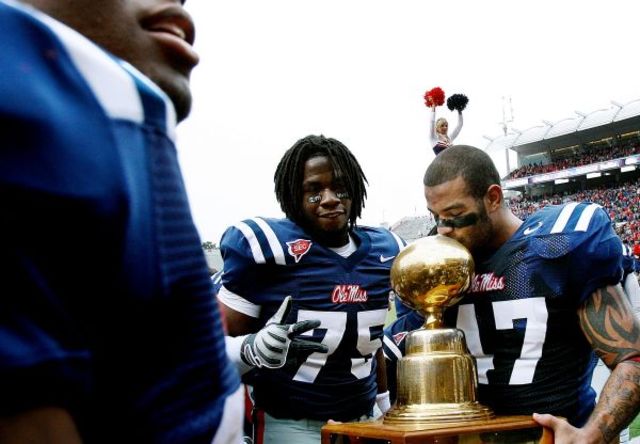
Tony Fein touches the Chucky Mullins Bust coming out of the players tunnel at Vault-Hemmingway Stadium—Photo Courtesy of Deste Lee

In September, Fein missed the final cut with Baltimore. He would have to wait until the next season to try out with another preseason team. The 27 year old wasn’t done. He returned home to the Seattle area to continuing training –– staying in shape expecting to try out with another team. A persistent Fein was even discussing the possibility of the Canadian Football League, as many teams were expressing interest. Sadly for Fein, having lived a life full of pure ambition, his chance to achieve the goals set before him would be cut short in a deadly accident.

In the morning of Oct. 6, 2009, The Ravens called Dee Hobbs to tell Tony to get ready. Due to injuries, a spot on their practice squad had opened up and they wanted Fein back in Baltimore. What they didn’t expect was Hobbs mournful response. Tony Fein was dead, the cause of death was uncertain. A wave of news reports broke across the globe from Washington to Arizona to Mississippi to Maryland to Iraq, covering a sweeping variety of readership. His brother Chird took the news the hardest, having looked up to Fein his entire life.

According to Hobbs, Fein had gone to stay with a friend in the city. He had never been much of a drinker, but they convinced him to have some fun. Unaccustomed to the dangers of alcohol, it was 8 o’clock on a Tuesday morning when Fein was found laying on his back having suffocated on his own fluids. A few days passed and autopsies proved that Fein had unintentionally mixed prescription medicine with the alcohol, resulting in an accidental drug overdose.

This is where the news about Tony Fein ends. Tests found a lethal mixture of morphine and anxiety medication in his system, reporters see the (then) pending charges of assault of a police officer, and everyone writes off this great American hero as some troubled soul in a matter of three months. What about everything this man had been working towards? What about his outstanding character, and his service to the country? Where’s the memorial? Where’s the scholarship?

A quick glance at this story, and this is what you see: War Veteran/Aspiring Athlete dies of a drug overdose. Not exactly the honorable discharge we were looking for, but you’re only seeing part of the story if you stop here. Morphine makes people think this guy cowardly turned to hard drugs to cope with being cut from the team, the war, whatever. It’s a drug that sounds fitting for an Iraq veteran and aspiring professional football player who probably suffers from painful back problems. Those who knew Tony personally would attest that suicide was out of question. People just seem to miss the “accidental” part.

Fein would have been a pleasure to coach, treating his teammates and coaches like soldiers and officers. He’s the kind of guy you want in the locker room with the ability to rally his teammates around a common goal. Had Fein’s tragic death been long and slow like the late Chucky Mullins, we might idolize his character in the same way we show respect to Mullins. As the Landshark continues to grow in popularity, we hope to see a trend toward this behavior.

From the center fold of Tony Fein’s funeral program—photo courtesy of Dee Hobbs

During the second half of the 2009 season, Ole Miss players wore a number 47 sticker on the back of their helmets in memory of the Original Landshark. It has been rumored that Ole Miss Athletic Director Ross Bjork is planning on making a new award in honor of Tony Fein. The award would be mirrored after the Chucky Mullins Memorial Courage Award, which is given to the player that best embodies Mullins’ spirit and courage.

So how do we, as fans, pay our respect to Tony Fein? Easy, keep those Fins Up! Keep throwing up the Landshark anywhere and everywhere, and whenever you do, remember the man who brought change to the Ole Miss community when we needed it the most, providing us the symbol for the Ole Miss Rebels that everyone can appreciate.